
NAEPC Webinars (See All):
Issue 49 – October, 2026
Planning Solutions for Unwinding Your Concentrated Stock
Emily Broxup, CFP®, ChFC®, Andrew S. Manganelli, MST, CFP®, ChFC®, RICP®, and Fred Ulbrick, CFP®, CIMA
I. INTRODUCTION
Concentrated stock, regardless of how acquired, results in a disproportionate allocation of wealth, and can expose taxpayers to considerable risk. Many clients hesitate to sell concentrated stock, whether attained through inheritance,executive compensation, or merely purchased years ago and held due to steep tax implications.
Some pivotal planning questions to consider before evaluating how to unwind a concentrated stock position include:
- What percentage of a client’s net worth are they comfortable holding in this stock?
- How much of the concentrated stock is needed to achieve financial independence and how much can be used for legacy planning?
- If the client acquired the stock through their employer, how much would they choose to hold in the company if they no longer worked there?
- Is the client aiming to derive a current (or eventual) income stream from the stock to provide for their retirement?
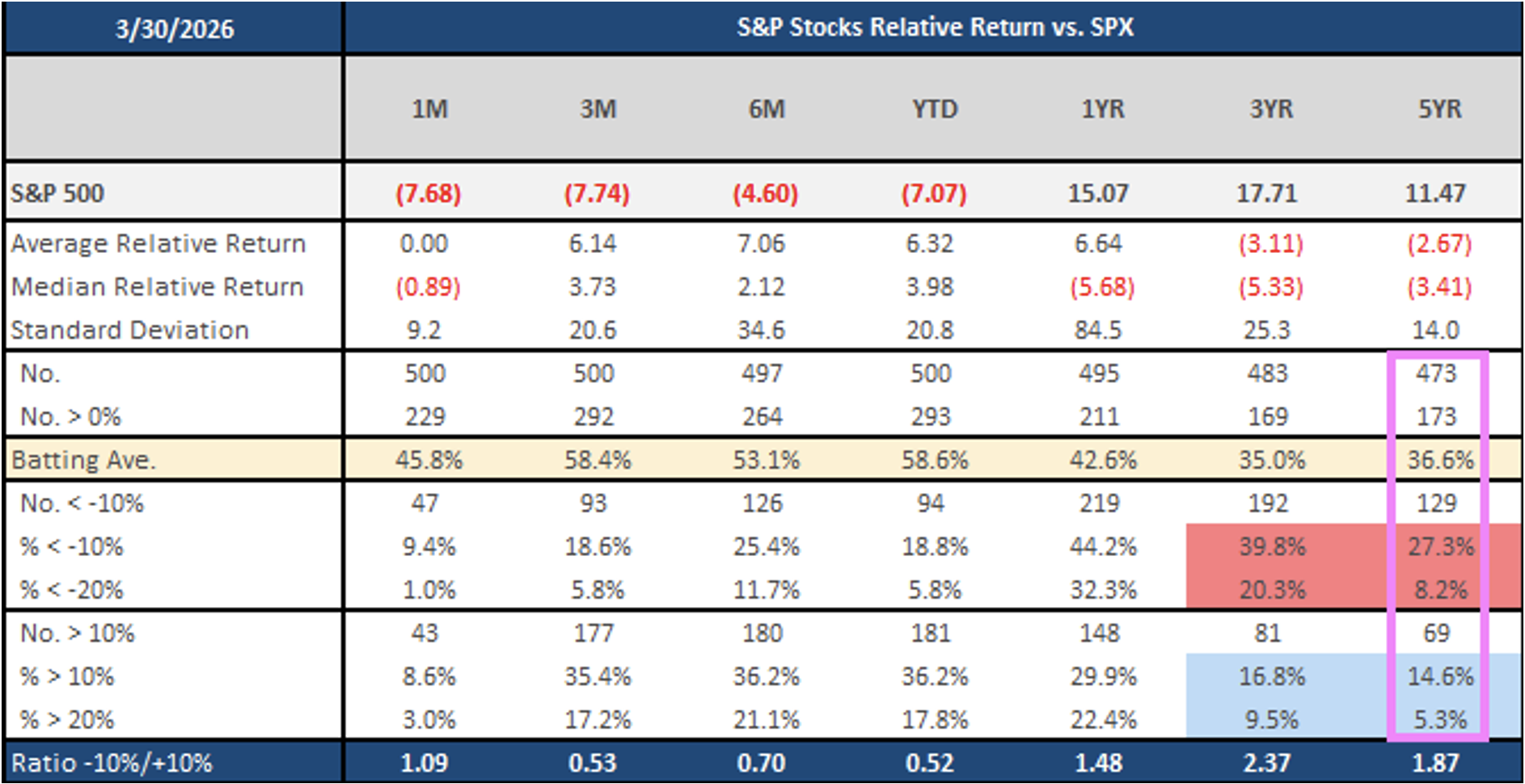
How much of the concentrated stock position would be held if there was a tax-efficient strategy to divest it? From an investment planning perspective, when looking at the S&P 500 in general, most individual stocks underperform thebroader index. Over the trailing five years, only 173 of 473 constituents (36.6%) outperformed. The data is further skewed to the downside with more stocks underperforming the index by 20% or more (8.2%) than outperforming by 20%or more (5.3%)[1]. This asymmetry is precisely why concentrated positions pose such a significant risk to financial plans and need a fundamentally sound tax planning solution for unwinding them.
II. TAX AND ESTATE PLANNING TECHNIQUES FOR CONCENTRATED STOCK
Concentrated stock positions are one of the most common tax planning challenges encountered. The financial industry has responded with a wide array of products marketed as “solutions,” such as 1) Exchange funds; 2) Optionoverlays; 3) Direct indexing; 4) Other structured strategies. While these products are presented as sophisticated tools, they share a consistent set of characteristics that tend to be expensive, complex, illiquid, or some combination of all three.
Critically, these strategies are designed to defer taxes, not eliminate them. The embedded tax liability does not disappear; it is simply restructured, often at meaningful cost and with significant strings attached. Exchange funds, forexample, require multi-year lockups, invest a portion of assets in illiquid private real estate to qualify for tax deferral, and deliver a basket of securities the client has no say in selecting. The tax tail, in these cases, is firmly wagging the planning dog.
Among the most effective approaches to concentration risk begins not with a product, but with a planning-based solution. In practice, this means combining tax planning-oriented tools with a disciplined, staged-selling program.
Let us look at a few of these planning-based methods of divesting concentrated stock, which can be used in isolation or combined depending on the facts and circumstances:
I. Staged Selling
- Entails selling a set number of shares over a defined period, which represents a viable alternative if liquidating them all at once is too difficult (the eventual result would be full liquidation).
- For example, if a taxpayer owned 8,000 shares of Microsoft stock, a reasonable target would entail selling 1,000 shares of the stock per quarter for the next two tax years. At that point in the future the stock will be fully divested,and proceeds are redeployed across a more diversified portfolio.
- Through this committed schedule, the objective is for a taxpayer to steady the course amidst market fluctuation. While clients may have their own emotions or attachments to the stock, the goal is to not let either of those stopsticking to the financial plan.
- This selling can often be best at the beginning of a tax year. This not only defers the potential payment of gains to tax filing deadlines for the following year, but it affords the ability to take advantage of market volatility and the potential for generating offsetting tax losses.
II. Annual Gifting
- If a concentrated position has grown significantly in value, it can be gifted directly to family members and/or charities.
- Gifting stock that is not needed for financial independence to children, who may be in a lower tax bracket, can represent a prudent form of income shifting.
- In 2026, annual exclusion gifting limits are $19,000 per beneficiary per year ($38,000 per beneficiary per year if gift-splitting), freely allowing this amount to be gifted to an unlimited number of recipients.
- It is important to note a direct gift results in a carryover basis to the recipient, while removing the security from the gross estate. Low basis securities in some circumstances should remain in an estate to receive a stepped-up basis at death.
III. Donor Advised Fund (DAF)
- A DAF is viewed as a charitable giving investment account. While contributions are irrevocable and no income stream is derived from it, taxpayers get an upfront tax deduction (if itemizing) and maintain flexibility to direct grants to desired charitable organizations as they wish.
- Contributions to a DAF offer an opportunity to diversify and rebalance, permitting the vehicle to grow tax-free for designated charities.
- The income tax deduction taken is the full Fair Market Value (FMV) up to 60% of Adjusted Gross Income (AGI) for cash gifts and the full FMV up to 30% of AGI for long-term appreciated securities such as publicly traded stock.
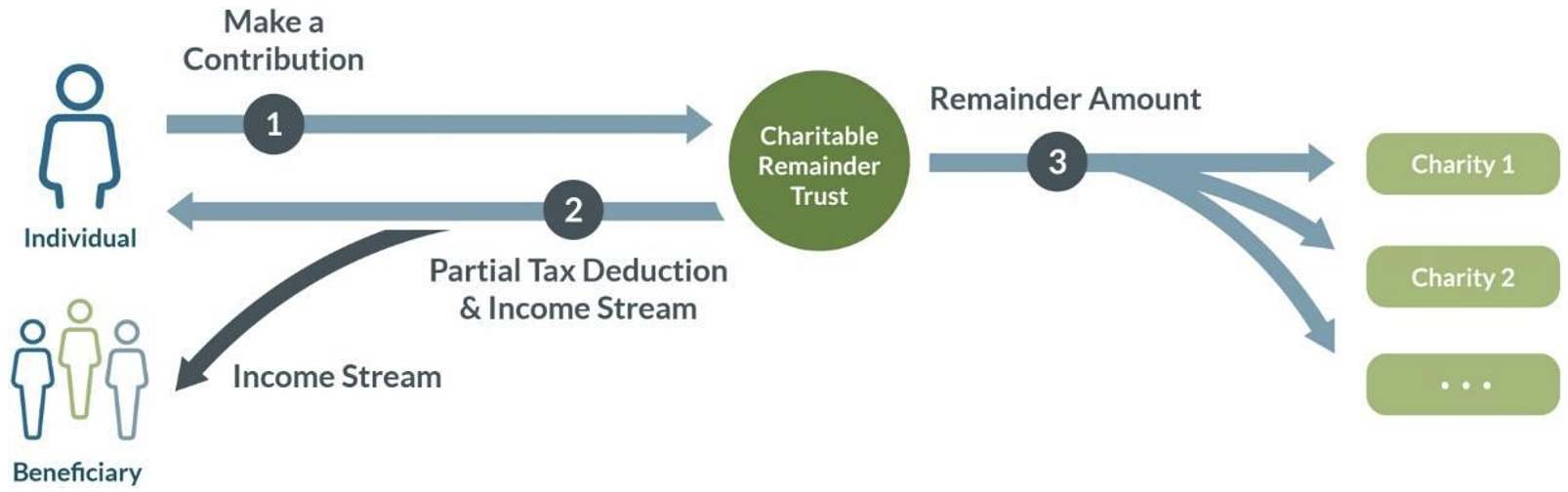
IV. Charitable Remainder Trust (CRT)
- A CRT provides multiple functions to divest concentrated stock. The suitable client profile for a CRT would be anyone who: 1) Wants an income stream in return; 2) Desires estate tax savings; 3) Prefers spreading out the tax liability over a number of years; 4) Seeks an immediate tax deduction in the year of donation (to potentially offset a large liquidity event).
- The taxpayer donates to the trust and receives an income stream paid from the trust over a period of time (either for life or a term of years not to exceed 20).
- Once a contribution is made into the CRT, the taxpayer may choose a specific dollar amount to receive in return or a specific percentage (ranging from 5-50% of the initial FMV donated)[2].
- An annuity trust pays a fixed dollar amount each year; an unitrust pays a fixed percentage of trust assets annually.
- Income is paid out in a worse-first sequencing, beginning with ordinary income, followed by current and accumulated capital gains.[3]
III. CONCENTRATED STOCK CASE STUDY-UNWINDING USING A CRUT
To help illuminate the power of planning techniques in handling concentrated stock, let us examine the following fact pattern. We will first outline some assumptions and then make a side-by-side comparison of two methods tounwind a concentrated $3M NVIDIA (NVDA) stock holding.
Core Assumptions*
- Taxpayers’ Ages: 60
- Tax Filing Status: Married Filing Jointly
- Joint life expectancy: 88
- Fair Market Value NVDA Stock: $3M
- Cost Basis NVDA Stock: 500k
- Taxable Income during CRT formation: $200,000 Ordinary Income
- CRUT & Non-Qualified Account Asset Growth Rate: 7%.
- CRUT Payout Percentage: Approximately 9%
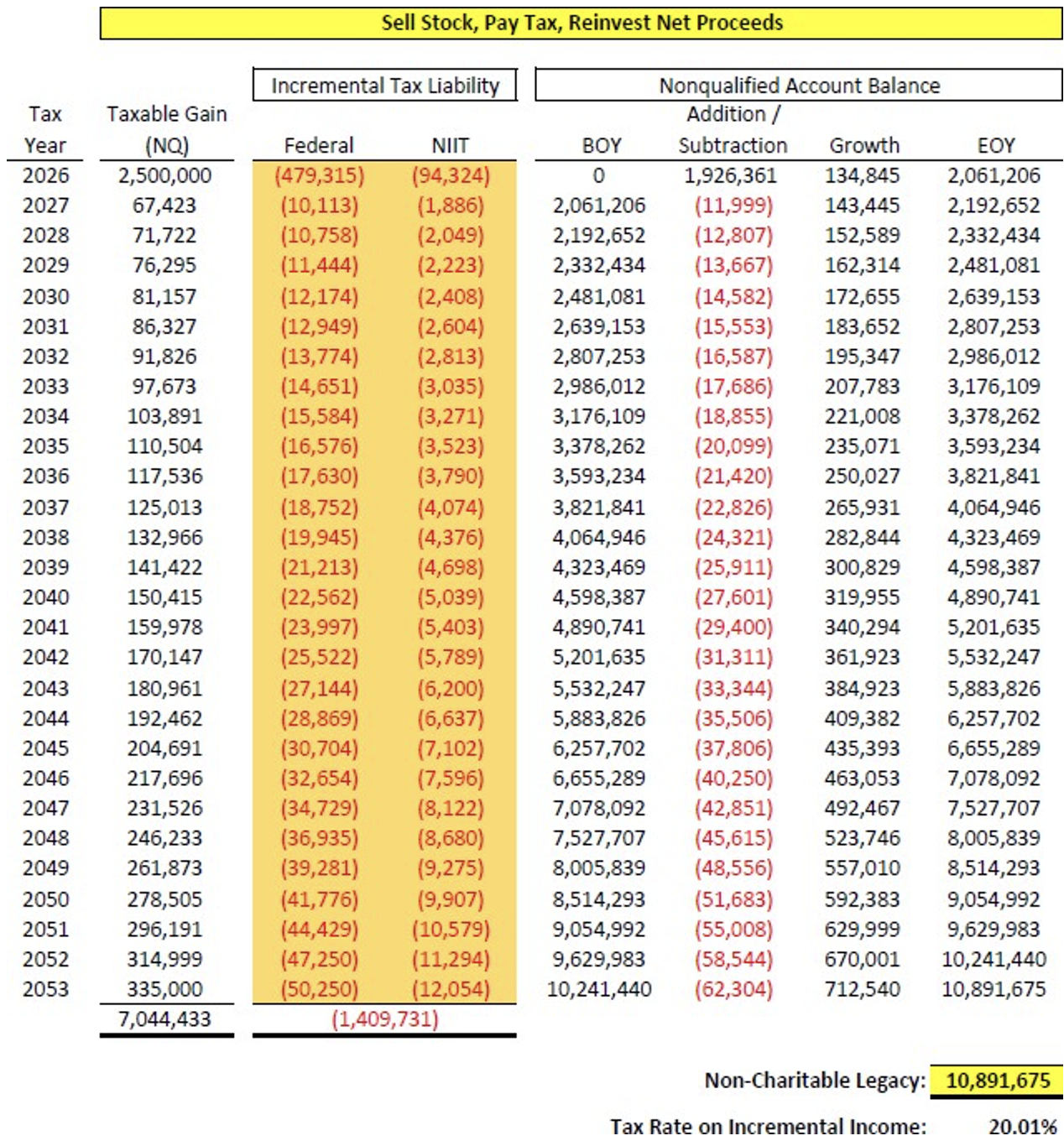
Consideration 1: Liquidate $3M NVDA stock position in full, pay capital gains tax, and reinvest the net proceeds into a diversified non-qualified account.
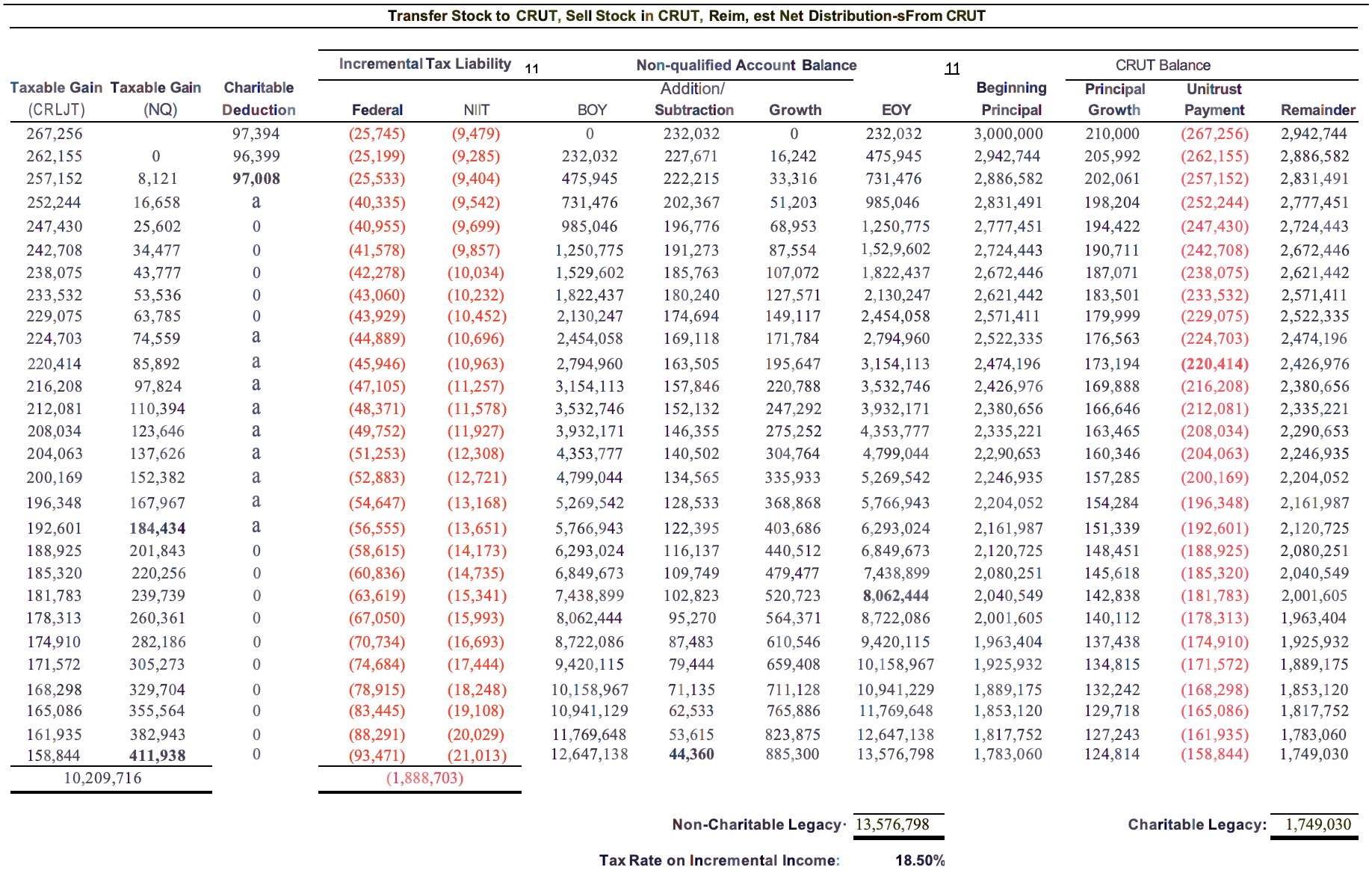
Consideration 2: Reposition all $3M of NVDA stock to a CRUT, have the trust sell the stock in an initial tax-exempt transaction, and then reinvest the proceeds into a diversified portfolio to pay out income, and thus spread out the taxes over time.
Key Results**
| Full Liquidation | CRUT Strategy | Differential | |
| Non-Charitable
Legacy |
$10,891,675 | $13,576,798 | +$2,685,123 |
| Charitable Legacy | $0 | $1,749,030 | $1,749,030 |
| Total Legacy | $10,891,675 | $15,325,828 | +$4,434,153 |
| Upfront Tax
Deduction |
$0 | $97,394 | +$97,394 |
| Upfront Tax Liability (Federal Capital
Gains + NIIT) |
$573,639 | $0 | -$573,639 |
This is provided for illustrative purposes only and should not be interpreted as financial advice.
*For a full set of all assumptions in their entirety, please refer to the appendix section
**For a full set of all results in their entirety, please refer to the appendix section
IV. CONCLUSION
There are a number of viable planning techniques to deploy to mitigate concentration risk. If left unattended, having exposure to concentrated stock can severely undermine a financial plan, especially if the full value is needed to secure financial independence. In many instances, a planning-based solution to unwind concentrated stock consists of staged selling, charitable techniques, outright gifting, or some combination of these strategies.
Given individual stocks have relative underperformance over time compared to the broader equity index, managing the inherent risks to concentrated stock positions with sizeable, embedded gains is a significant component to afinancial plan. A Charitable Remainder Unitrust (CRUT) can help achieve income during retirement while helping to divest tax-efficiently divest a concentrated position with a large, embedded capital gain. This technique comes into play when taxpayers of strong charitable intent are seeking to spread out the tax liability over time from a concentrated position, secure an income tax deduction in the year of donation, obtain a degree of estate tax savings, and create an income stream for their own retirement.
Appendix
[1] Park Avenue Capital (2026) and Bloomberg Financial LP (2026), S&P Stock Relative Return vs. SPX
[2] I.R.C. § 664(d)(1)(a)
[3] I.R.C. § 664(b) (1-4)
Authored by:
Andrew Manganelli, MST, CFP®, ChFC®, RICP® – Director of Financial Planning at Park Avenue Capital www.pac.nm.com
Emily Broxup, CFP® – Financial Planning Associate www.pac.nm.com
Frederick Ulbrick, CFP®, CIMA® – Director of Portfolio Management at Park Avenue Capital www.pac.nm.com
Disclosure
This publication is not intended as legal or tax advice. The information was compiled by Park Avenue Capital and is intended solely for the information and education of their customers, and the legal and tax advisors of those customers. It must not be used as a basis for legal or tax advice and is not intended to be used and cannot beused to avoid any penalties that may be imposed on a taxpayer.
Northwestern Mutual and its financial representatives do not give legal or tax advice. Taxpayers should seek advice regarding their particular circumstances from an independent legal, accounting, or tax advisor. Tax and other planning developments after the original date of publication may affect these discussions. Theopinions expressed are those of Park Avenue Capital as of the date stated in this material and are subject to change. There is no guarantee that the forecasts made will happen. Information and opinions are derived from proprietary and non-proprietary sources.
Park Avenue Capital is a marketing name for doing business as representatives of The Northwestern Mutual Life Insurance Company, Milwaukee, WI, and its subsidiaries. Northwestern Mutual Private Client Group is a select group of NM advisors and representatives. Park Avenue Capital and Northwestern Mutual Private Client Group are not a registered investment advisers, broker-dealers, insurance agencies, federal savings bank, or other legal entities. To view detailed disclosures regarding individual representatives, view their information at pac.nm.com.