
NAEPC Webinars (See All):
Issue 49 – October, 2026
How a Young Donor’s CRUT Keeps Paying After an Early Death
Klaus Gottlieb, JD
| Synopsis. A charitable remainder unitrust (CRUT) normally stops paying when the measuring life ends. The Treasury regulations, however, expressly permit a CRUT to pay for the longer of a life or a fixed term of up to 20 years. Under that longer-of period, an early death does not end the payout: named successors receive the unitrust amount for the balance of the guaranteed term. For younger donors, the protection is inexpensive, and no commercial insurance product replicates it. But qualification, gift, estate, and generation-skipping consequences must be modeled before the instrument is signed. |
The classic charitable remainder unitrust (CRUT) donor is an older investor with appreciated assets, a desire for lifetime cash flow, and a charitable objective. A younger donor may arrive with the same assets after a public offering or business sale, but with a spouse, dependent children, and decades of family obligations ahead. A CRUT can sell contributed appreciated assets without immediate recognition of taxable gain to the donor, while its four-tier system carries income and taxable gain out over time.1 The author’s Monte Carlo analysis in the Journal of Financial Planning shows that, for a well-defined class of donors, the CRUT outperforms the taxable alternatives even after the charity’s share is counted.2 That result makes the structure worth serious consideration for the young liquidity-event donor. It also sharpens a question that older donors rarely have to ask.
A life-only CRUT ends its payments the day the last measuring life ends, and, for that younger family, the risk is that this day arrives early. The corpus then passes to charity and the payouts stop. The family loses both the donor and a cash-flow stream on which its planning depended.
The Treasury Regulations supply another choice. A CRUT may pay for any of: (1) a life or lives, (2) a fixed term not exceeding 20 years, or (3) the shorter or the longer of the two. In the longer-of form, named successors receive the unitrust amount after an early death until the fixed term expires. Nothing about the payment changes at death; only the recipient does.
A payout period hiding in the regulation
Section 664 of the Internal Revenue Code (the “Code”) describes the familiar life and term alternatives for these CRUTs. Treasury Regulation Section 1.664-3 then gives the critical example: a fixed percentage may be paid to A for life or for a term of not more than 20 years, “whichever is longer (or shorter).” That parenthetical creates a planning choice that is easy to miss because it appears as an example rather than as a named category.3
Consider a single-life CRUT with a 20-year longer period, sometimes described as a life-plus-term or guaranteed-term design. If the donor dies in year 7, the instrument directs the unitrust amount to then be paid to a spouse, children, or other named recipients through year 20; if the donor survives year 20, payments continue to the donor for life. In a two-life CRUT, the continuation matters only if the second death occurs before the 20-year term date. The Service approved this two-life architecture in a private letter ruling: if both measuring lives died during a 20-year guaranteed period, the balance of the term passed to children for continuing unitrust payments.4 Recipient provisions still matter: successors must fit the regulation, and the instrument should state the payment and proration convention at death.5
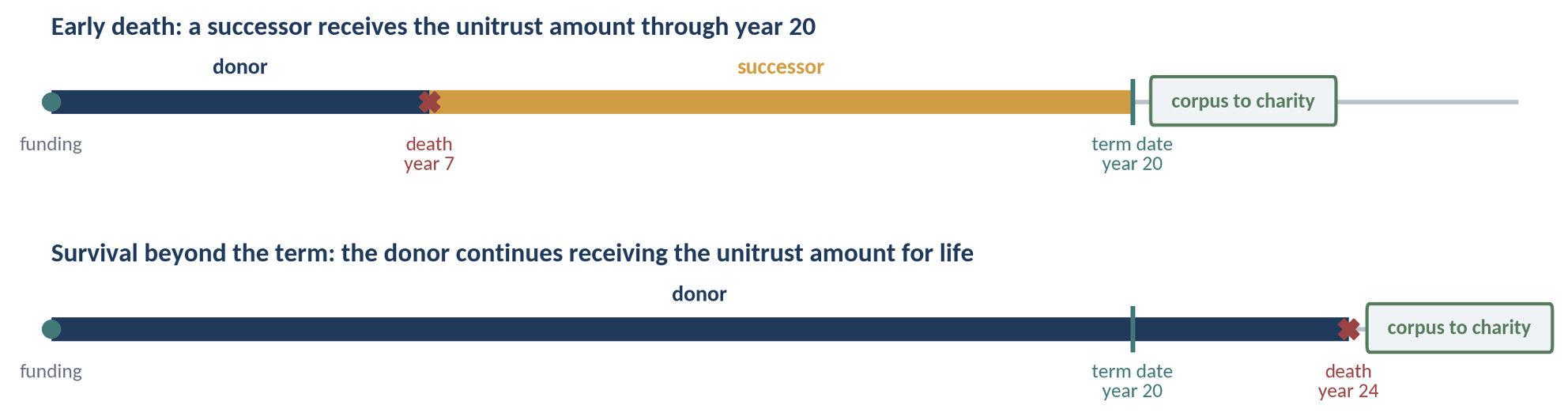
Figure 1. A 20-year longer-of period. An early death shifts the unitrust amount to a named successor for the balance of the term; survival beyond the term leaves the donor’s lifetime payout unchanged.
| The central distinction. The longer-of term extends the payout period in the early-death branch of the trust. It does not add outside capital or guarantee a fixed dollar benefit; the successor(s) simply step into the unitrust payments the donor was receiving. |
What must happen for the feature to pay?
The feature pays only if the measuring lives end before the guaranteed term does. For a single-life CRUT, the trigger is the donor’s death within the term; for a two-life CRUT, it is the second death within the term. That difference in trigger, not any difference in benefit, is why a young couple’s actuarial cost can be dramatically lower than a single donor’s at a similar age.
Table 1. Probability that the continuation feature is triggered under Table 2010CM. Couple calculations use ages x and x+2 and a second-death trigger.
| Measuring life or lives | 10-year term | 20-year term |
| Single life, age 30 | 1.254% | 3.842% |
| Single life, age 40 | 2.621% | 8.366% |
| Single life, age 50 | 5.900% | 17.265% |
| Two lives, ages 30 and 32 | 0.018% | 0.172% |
| Two lives, ages 40 and 42 | 0.082% | 0.813% |
| Two lives, ages 50 and 52 | 0.401% | 3.438% |
For example, at ages 40 and 42, the statutory probability of a second death within 20 years is about 0.81 percent, roughly one chance in 120; within 10 years, it is about 0.08 percent, roughly one in 1,200. For a single measuring life of an individual (age 40), the 20-year figure is about 8.37 percent, one in 12. Both parents dying while the children are still young is rare, and its rarity is exactly why the protection costs so little.
These are valuation probabilities, not individualized forecasts. Table 2010CM is the statutory table, not medical underwriting; the two-life illustration treats the lives independently and does not capture common-cause deaths or the lower mortality of affluent, insurable donors. Use the table to value the CRUT; do not present it as a prediction about a particular household.6
Who bears the cost of the longer-of feature?
The successors’ contingent interest has actuarial value, and where that value comes from depends on the payout regime.
At a payout below the permissible maximum, it comes out of the charitable remainder. For a married couple (ages 41 and 43), adding a twenty-year floor, the remainder falls by about $984, and the donor’s deduction is smaller by the same amount. The donor’s distributions do not change.7
At the maximum payout, the ten-percent test allows, the remainder is pinned at the ten-percent floor by definition, and the deduction with it: $100,000 per million, with or without the guarantee. The successors’ interest is funded instead by the donor’s reduction of the payout rate. For a married couple (ages 39 and 41), the plain two-life trust qualifies at about 5.0953% and the guaranteed trust at about 5.0792%, a difference of 0.016 percentage points, roughly $161 of first-year unitrust amount per $1 million and proportionally on every payment for the life of the trust.8
Two regimes, two currencies: a smaller remainder and deduction below the ceiling, a smaller distribution at it.
| Calculation assumptions. $1,000,000 standard CRUT; 5.2 percent stated payout; quarterly payments at the end of each quarter; 5.2 percent section 7520 rate (July and August 2026); Table 2010CM; adjusted payout rate 5.0383357%. Values are rounded and should be recomputed for the actual funding date, elected valuation month, payment convention, ages, and the governing instrument. |
Table 2. Actuarial effect of adding a 20-year longer-of floor at a fixed 5.2% payout. All rows shown satisfy the 10% remainder test. The last column is the probability, under Table 2010CM, that the measuring lives end within the term (second death for couples), i.e., that the successors receive any payment.
| Structure | Life-only remainder | Longer-of-20 remainder | Reduction | 20-year trigger probability |
| Single life, age 32 | $112,439 | $103,874 | $8,564 | 4.483% |
| Two lives, ages 41 and 43 | $105,420 | $104,437 | $984 | 0.942% |
| Two lives, ages 55 and 57 | $205,141 | $197,500 | $7,641 | 7.078% |
| Two lives, ages 75 and 77 | $476,655 | $345,674 | $130,981 | 80.014% |
The single-life age-32 case reduces the remainder by about $8,564, more than the married couple, because one death rather than two deaths activates the feature. For recipients ages 75 and 77, the second death within twenty years is no longer remote, and the reduction reaches about $131,000. The last column (20-year trigger probability) drives the third column (reduction in the remainder interest).
The usable deduction may be affected by Code Section 170 percentage limits, Code Section 170(e), itemization, state law, and the five-year carryforward for charitable deductions. Table 2 reports actuarial remainder values, not the deduction on the donor’s tax returns.9
Qualification is the gatekeeper
A CRUT must pay at least 5% and no more than 50 % of the fair market value of the trust’s assets, recalculated annually, and the actuarial value of the charitable remainder must be at least 10 % of the initial fair market value of such assets. The longer-of term reduces the remainder value, so a design that qualifies without the 20-year floor may fail these requirements after this floor is added.10
Table 3. Minimum qualifying age under the same assumptions. For two-life cases, the younger life is shown, and the second life is two years older.
| Payout-period structure | Minimum age at 5.2% payout | Minimum age at 5.0% payout |
| Single life | 30 | 28 |
| Single life + 5-year floor | 30 | 28 |
| Single life + 10-year floor | 30 | 28 |
| Single life + 15-year floor | 31 | 29 |
| Single life + 20-year floor | 32 | 30 |
| Two lives | 40 | 39 |
| Two lives + 5-year floor | 40 | 39 |
| Two lives + 10-year floor | 40 | 39 |
| Two lives + 15-year floor | 40 | 39 |
| Two lives + 20-year floor | 41 | 39 |
The boundary shifts are small but not irrelevant. For recipients ages 40 and 42, a plain two-life CRUT with a 5.2% unitrust payout produces a remainder value of about $100,350 and qualifies under the Code; adding a 20-year floor, however, reduces this remainder value to about $99,511, so the same payout fails, and reducing the stated payout to approximately 5.1887% restores qualification. For recipients below age 39, no two-life trust qualifies at any permissible payout, so a married donor in his or her thirties is limited to a term-only CRUT, a single-life longer-of CRUT with a spouse or children as term successors, or separate life insurance. Each solves a different problem.
Three transfer-tax designs
The identity of the successor determines whether the contingent interest is sheltered by the marital deduction, consumes gift-tax exemption, remains incomplete, or creates a generation-skipping transfer tax issue.
1. Spouse as the only successor
In a single-life CRUT, the spouse may receive the balance of the fixed term if the donor dies early. If the spouse is the only noncharitable beneficiary other than the donor, Code Section 2523(g) allows a marital deduction for the spouse’s unitrust interest, which need not last for his lifetime. This is the cleanest design for restoring cash flow to the surviving spouse. Its limitation is equally clear: it does not protect (dependent) children after both spouses are gone.11
2. Children or grandchildren as successors
A child’s right to the remaining payments is contingent: it pays only if the parent-recipients die within the CRUT term. That contingency affects the value of the taxable gift, not whether a taxable gift has been made. If the donor names the children irrevocably, the taxable gift is complete at funding, and its taxable value is the actuarial value of the contingent interest, the same small figure the remainder fell by. As a future interest, it does not qualify for the annual gift tax exclusion; it reduces the donor’s lifetime gift tax exemption. A grandchild or other skip person adds generation-skipping transfer tax analysis to our inquiry. Once children are noncharitable beneficiaries alongside the surviving spouse, Code Section 2523(g) no longer permits the application of the marital deduction for the surviving spouse’s own successor interest.12
3. The donor retains a testamentary power to revoke
The Treasury Regulations permit the donor to retain, exercisable only by will, a power to revoke a noncharitable recipient’s term interest. The gift is then not complete at funding: no exemption is used and nothing is reported. If the donor dies within the term without revoking this interest, the interest is included in the donor’s gross estate, where the applicable estate-tax exclusion generally absorbs it; if the donor outlives the term, the interest simply expires. This is not transfer-tax erasure: the donor’s retained unitrust interest remains subject to Code Section 2036, the retained power to Code Section 2038, and any skip-person interest to the estate-tax inclusion period rules. For most young donors, it is nonetheless the preferable design because it defers the transfer-tax question to the rare state in which the guarantee actually pays.13
| Transfer-tax takeaway. The spouse-only design, a completed gift to descendants, and a retained testamentary revocation power are different tax architectures, not drafting styles. Select the architecture first; then run the actuarial calculation. |
Compare it with life insurance
The life insurance analogy identifies the risk: an early death can end expected family cash flow from the CRUT. Beyond that, the products diverge, as Table 4 shows below. Survivorship coverage is currently sold in permanent forms; industry sources indicate that survivorship term, the closest commercial analog to the two-life, longer-of feature, is not presently offered by carriers, though product availability changes and current illustrations should always be obtained.14 Life insurance is the better tool when the family needs a fixed amount at death, liquidity outside the trust, or protection beyond 20 years. The longer-of term is attractive when the objective is narrower: to prevent an early death from ending the CRUT payment stream. The two can be complementary.
Table 4. Comparison of the longer-of CRUT and common life-insurance structures.
| Feature | Longer-of CRUT | Single-life term insurance | Survivorship permanent insurance |
| Trigger | Death before the floor expires; second death for a two-life CRUT | Insured’s death during the policy term | Second insured death while policy remains in force |
| Benefit | Variable series of unitrust payments | Stated death benefit | Stated death benefit |
| Funding source | Assets already inside the CRUT | Premiums plus insurer risk pool | Premiums plus insurer risk pool |
| Underwriting | None | Generally required | Generally required |
| Income-tax character | Section 664(b) tiers | Generally section 101(a) | Generally section 101(a) |
| Primary planning use | Continue an existing trust payment stream | Create liquidity after one death | Create liquidity after the second death |
A practical planning sequence
Define the risk. First death, second death, fixed liquidity, or continuity of CRUT payments?
Run qualification first. Test payout, frequency, Code Section 7520 interest rate, ages, and term against the 10% remainder rule and 5% ≤ x ≤ 50% unitrust payout.
Choose the tax architecture. Spouse-only, completed-descendant, and revocable-successor designs have different gift, estate, marital, and GST results.
Name successors precisely and plan administration. Shares, contingencies, death proration, predeceased successors; annual valuations, Form 5227, Schedule K-1.
Conclusion
The longer-of CRUT is a permitted payout-period election with a precise function: if death occurs during a stated window, the unitrust amount continues to name successors rather than accelerating to the charity remainderman. For younger donors, especially in a two-life design, the actuarial cost is modest, and the protection has no ready commercial equivalent. At the qualification frontier, however, even a modest cost can determine whether the CRUT qualifies at all. The planning rule is therefore not “use the longer-of CRUT.” It is “ask the longer-of question before choosing the payout period,” then model the income-, gift-, estate-, and generation-skipping transfer tax consequences.
Notes
- I.R.C. §§ 664(b), 664(c), 664(d)(2); IRS, Charitable Remainder Trusts (payments retain character under the four-tier system; the deduction is limited to the present value of the remainder).
- Klaus Gottlieb, “When Does a Charitable Remainder Unitrust Outperform? A Monte Carlo, Multi-Benchmark Suitability Framework,” Journal of Financial Planning 39, no. 8 (2026): 60–79.
- I.R.C. § 664(d)(2)(A); Treas. Reg. § 1.664-3(a)(5)(ii)(b) (payment to A for life or a term not longer than 20 years, whichever is longer or shorter).
- Priv. Ltr. Rul. 9331043; I.R.C. § 6110(k)(3) (written determinations may not be cited as precedent).
- Treas. Reg. §§ 1.664-3(a)(3)(i), (a)(5)(i).
- Treas. Reg. § 1.664-4; Treas. Reg. § 20.2031-7(d)(7)(ii), Table 2010CM; T.D. 9974, 88 Fed. Reg. 37,084 (June 7, 2023). Probability illustrations use Table 2010CM l(x) values; two-life values multiply the respective cumulative death probabilities.
- Treas. Reg. §§ 1.664-4(a), (e) (remainder value, computed on Table 2010CM life contingencies as to each life involved, is the deductible amount for §§ 170, 2055, 2106, and 2522); § 1.664-3(a)(1)(i) (unitrust amount as fixed percentage of annual net fair market value); Treas. Reg. § 25.2512-5(d) (gift-tax valuation on the same actuarial basis). The two-price observation follows from these provisions and I.R.C. § 664(d)(2)(D); it does not appear in the practitioner literature.
- Author’s calculation under Treas. Reg. § 1.664-4, solving for the stated payout at which the remainder factor equals exactly 10 percent. The plain two-life ceiling is reproducible on standard planned-giving software; the longer-of ceiling on any tool exposing the longer-of election. Ceilings are sensitive at the fourth decimal to factor-rounding and payment-timing conventions; the first-order concession is not.
- I.R.C. §§ 170(b), (d), (e); Treas. Reg. § 1.664-4(e)(5)– (6); IRS Publication 1458, Actuarial Valuations Version 4B. Calculations use the direct regulatory formulas, cross-checked against the published IRS examples and validated against commercial planning software at twelve points, with agreement within $33 per $1,000,000 of corpus.
- I.R.C. §§ 664(d)(2)(A), (D).
- I.R.C. §§ 2523(g), (i); Treas. Reg. § 25.2523(g)-1(a) (the spouse’s interest need not be for life).
- I.R.C. § 2503(b); Treas. Reg. § 25.2503-3; Treas. Reg. § 25.2702-1(c)(3)(i) (standard-CRUT exception); I.R.C. §§ 2601–2664; Treas. Reg. § 25.2523(g)-1(a)(5) (noncharitable beneficiary means any beneficiary other than a § 170(c) organization); see Treas. Reg. § 20.2056(b)-8(b); CCA 202233014.
- Treas. Reg. §§ 1.664-3(a)(4), (a)(5)(i) (retained power exercisable by will to revoke a term interest); 25.2511-2(b), (c); Estate of Sanford v. Commissioner, 308 U.S. 39 (1939); I.R.C. §§ 2036, 2038, 2642(f); Treas. Reg. § 20.2036-1(c)(2); Treas. Reg. § 20.2055-2(e)(2)(v).
- Survivorship coverage is offered by major carriers in indexed and variable universal life forms (product materials accessed August 2026); industry commentary indicates second-to-die term is not currently sold. IRS section 7520 interest rates (July and August 2026: 5.2%).
 About the Author
Klaus Gottlieb, JD, MBA, LLM (Tax), is an estate and tax planning attorney in San Luis Obispo, California, whose statewide practice concentrates on the design of charitable remainder trusts. He teaches at the Monterey College of Law and writes on the quantitative design of split-interest trusts. www.calcrut.com