
NAEPC Webinars (See All):
Synopsis. The middle-class long-term care funding gap is often mischaracterized as a matter of how much a household has saved relative to their anticipated cost of care. It is better understood as a matter of form that such savings take. Middle-class households often hold their net worth in a home and a retirement account—assets that are illiquid, tax-encumbered, or, in the case of the home’s equity, exempt from Medicaid’s reach (up to a limit) yet difficult to access without selling or causing some unintended consequence. Long-term care demands immediate and sustained cash flow, and eligibility for institutional Medicaid turns not only on the value of an applicant’s assets, but on the nature of the assets themselves. This article examines that mismatch and analyzes the Medicaid Compliant Annuity as a mechanism for converting problem assets into a compliant income stream, providing respite from a storm of long-term care expenses that would otherwise ravage an applicant’s finances.
A Bill the Middle Class Cannot Pay and Cannot Escape
Roughly seven in ten people who reach age 65 will need long-term care at some point, and the bill is not modest: a semi-private room in a nursing home at the national median cost now runs about $114,975 per year.1 Set against a middle-class balance sheet, which is not an expense that can be readily absorbed. In fact, long-term care expenses can challenge individual and household solvency. For estate planners, this is precisely the kind of risk that can quietly unravel even a well-constructed plan.
The instinctive response—save enough to pay for one’s care—flounders on the nature of the risk. Most who need long-term care need it briefly, but more than one in five will need it for over five years.2 The cost follows the same trend, in that lifetime care costs average about $120,900 per person—families pay roughly a third out of their own pockets—yet the burden is uneven. Some people spend little, while about one in seven pay more than $100,000 themselves. 2 A household can plan for the average cost and still be ruined by an uncapped, open-ended liability. It is that gap between the average and the extreme that makes long-term care one of the most consequential and most neglected exposures in a client’s financial life, and one that belongs squarely in the estate planning conversation.
The private market has not filled that space. At least not ostensibly. Fewer than 8 percent of adults aged 60 and older held a long-term care insurance policy as of 2022.3 That means the realistic long-term care financing endpoint for many middle-class households is Medicaid. That is the rational destination for a risk that cannot be self-funded and is largely uninsured. But Medicaid eligibility is not guaranteed.
The Wrong Kind of Assets
Most households hold their net worth in two assets that present significant liquidity problems—a home and a retirement account. Both asset types are typically inaccessible when the nursing-home bill comes due. That is, at least in terms of immediate liquidity.
Consider where many individuals park the lion’s share of their accumulated asset value. For individuals aged 65 to 74, the value of these assets’ peaks at a median of about $409,900,4 but the composition is lopsided. The bulk of this value is tied up in the home, with only a single-digit share held in cash.5
National data tell the same story. The Federal Reserve’s Distributional Financial Accounts show that the middle 40 percent of households hold about 29 percent of the nation’s net worth but 46 percent of its real estate, and only 12 percent of directly held stocks and mutual funds. What financial assets they do hold sit mostly in retirement and pension accounts, largely illiquid forms.6 For the middle class, “net worth” typically means a home and a retirement account, with little else to draw upon.
That asset allocation splits the household into two piles in the long-term care context. One large pile is the home. As shown below, the home is generally exempt from the asset test for institutional Medicaid, so it is not what stands between the household and eligibility. But it is illiquid and cannot pay a nursing home bill without being sold or borrowed against. Moreover, selling the home to cover nursing home expenses comes into friction with long-established estate-planning goals in the individual sense, and with the American tradition of passing assets to the next generation.
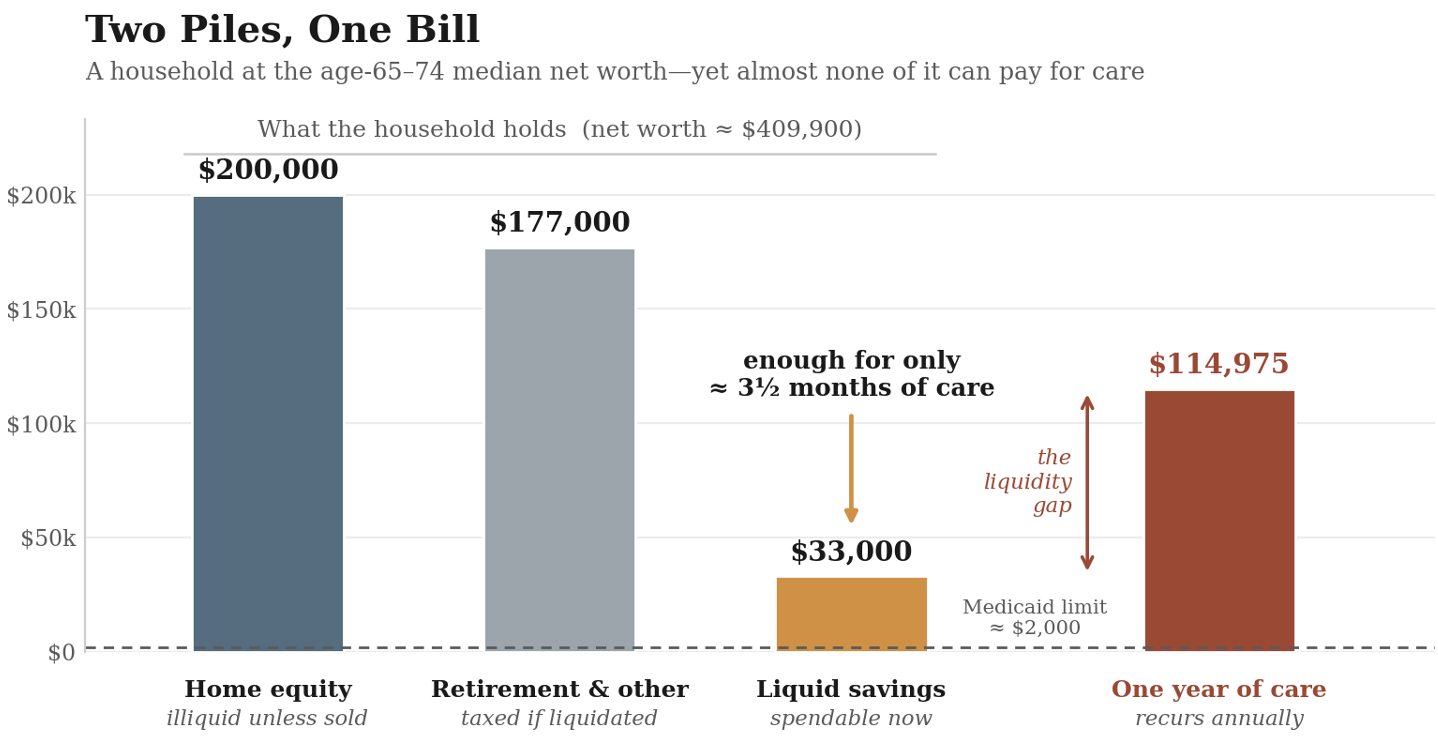
Figure 1. Two Piles, One Bill. A representative household at the age-65–74 median net worth, split into the exempt home and the countable financial resources it must draw on for care, shown against the $2,000 resource limit and the annual cost of a semi-private nursing home room. The mismatch: the liquid, spendable slice is a fraction of a single year’s care; the retirement pile cannot be reached without a tax bill; and the largest asset, the home, is exempt but cannot pay the bill without being sold.
Sources: net worth and home equity, Federal Reserve Survey of Consumer Finances (note 4); liquid share derived from Federal Reserve portfolio data (note 5); cost of care (note 1); resource limit (note 12). Allocations within net worth are illustrative.
A separate pile is the household’s financial resources—bank accounts, certificates of deposit, investments, and, in many states, retirement accounts.7 The institutional Medicaid eligibility rules render many such financial resources “problem assets.” They are countable and a barrier to eligibility in their current form but changing the assets’ form triggers some other consequence, such as a period of ineligibility if a transaction is considered a transfer for less than fair market value. Depending on the state, this can be an immense concern with retirement accounts, which generally cannot be reached without triggering a significant tax liability. The household is asset rich and cash poor, with a modest net worth, a thin liquid reserve, and a care bill that dwarfs any liquid reserves.
A Rule That Counts Dollars, Not Their Form
For institutional long-term care Medicaid, the home is an excluded resource, up to a home equity limit.8 The exclusion runs through Supplemental Security Income methodology, which leaves the home out of countable resources altogether. The exemption survives a move to a facility so long as the applicant signs an intent to return. While the home itself does not block eligibility, it does nothing to help pay for long-term care.
Along with the home exemption comes two key points of consideration. First, as referenced above, the exclusion is not unlimited. For long-term care coverage, home equity above a threshold—$752,000 in most states in 2026, and as much as $1,130,000 in others—turns the home from an exempt asset into a bar on coverage, a ceiling keyed to the value of a single asset rather than to the household’s total resources.9 A middle-class home sits well below that ceiling, so the exemption typically holds. However, the ceiling is now frozen. Beginning in 2028, federal law caps the home equity limit at a flat $1,000,000 and ends the annual inflation adjustment for all but agricultural property.10 Second, the exempt home is not beyond reach forever. For recipients aged 55 and older, states must recover long-term-care costs from the estate at death, and the home is typically the asset they reach, though recovery is deferred while a community spouse remains living.11
What tends to prevent eligibility is the countable financial asset pile. To qualify for Medicaid, an applicant generally may hold no more than $2,000 in countable resources.12 Countability turns on a formal notion of “availability”—whether a resource can be converted to cash and applied to care—not on whether it can be reached without cost. Cash in a checking account and money locked in a taxable retirement account can both be deemed available and countable even though only the former can be spent without a tax bill. A household with a paid-off home and a few hundred thousand dollars in savings and retirement accounts is well above the $2,000 limit, yet cannot begin to self-fund a catastrophic, multi-year stay for lack of liquid financial resources.
The middle class is caught in the uncomfortable position the program creates: countable resources well above the $2,000 limit with too little liquidity and too much embedded tax exposure to cover the cost privately. For married couples, the spousal impoverishment rules attempt to soften the edge, protecting a Community Spouse Resource Allowance and a monthly income floor.12 But a floor is all they protect, and the problem assets evade a solution.
The Costliest Way Out
Faced with an apparent eligibility wall, the intuitive move for many is to liquidate everything and privately pay until their hard-earned, long-saved money is gone. It is the wrong move twice over—and that is before considering how thoroughly the move runs contrary to both the longstanding tradition of passing one’s remaining assets to the next generation and the public policy of preventing spousal impoverishment in married couple scenarios.
The first error is selling the home. The home did not need to be sold—it was exempt—so liquidating it buys no eligibility. It also forfeits a potential step-up in basis the home could have received at death, converting a lifetime of untaxed appreciation into a realized gain, all to raise cash that was not required.13
The second error is another expensive one: fire-selling the countable savings and draining the retirement accounts. Every dollar pulled from a traditional IRA is ordinary income,14 and funding a multi-year bill compresses those withdrawals into a short window. A couple sitting comfortably in the 12 or 22 percent tax bracket can be pushed into the 24 or 32 percent tax bracket by the liquidation itself.15 State law varies on whether a retirement account counts as an available resource,16 but that variation offers no relief from the tax. Countable or not, liquidating the account is a taxable event, so a household that must tap it to qualify is taxed for the privilege.
One final point on the home is that the state can access the home and its attendant value via estate recovery following death.17 Tally the layers—an unnecessary home sale, a forfeited basis step-up, accelerated income tax, and potential recovery. This path does not merely spend the estate; it spends far more of it than the household ever needed to, destroying value a structured approach could preserve.
Converting Countable Resources into Income
The Medicaid Compliant Annuity is built to solve this dual long-term care financing and estate preservation problem. Authorized within the framework of the Deficit Reduction Act of 2005, a compliant annuity converts a single premium—drawn from the individual’s problem assets—into an income stream that is actuarially sound, non-assignable and non-transferable, irrevocable, and payable in equal installments, with the state named as remainder beneficiary to the extent of the benefits paid.18 An annuity structured thusly is, pursuant to federal law, non-countable as a resource and triggers no penalty period of ineligibility, because the purchase is not considered a transfer for less than fair market value.19
Read through the lens of the household balance sheet, the instrument has a singular economic function: it changes the form of those assets. A countable lump sum becomes a stream of income, which the rules treat differently from a resource—and it does so without touching the exempt home, which stays where it is. The strategy hides nothing as the disclosure requirements provide the state transparency related to its remainder interest. Where a married couple is involved, the stream can be structured to best support the at-home spouse, converting excess countable resources into a financial lifeline.20
The instrument does not run contrary to the language or spirit of eligibility rules. In fact, the Medicaid Compliant Annuity is expressly provided for in those rules. Moreover, the MCA resolves a mismatch of the eligibility rules created between the assets an applicant has and the liquidity they can actually access. It does so all the while leaving the home, the household’s largest and most protected asset, untouched.
Matching Resources to Liability
The middle-class long-term care funding gap has been misdiagnosed as a problem of means. It is a liquidity problem, and beneath that a problem of form. These households are not too rich to need help and not rich enough to go it alone. They hold resources in forms that cannot meet the liability in front of them—a home that is exempt but unspendable and retirement savings that cannot be reached without a tax bill. And the applicable rules turn on the form those resources take in addition to their monetary value. For estate planners advising clients across this demographic, that distinction is the difference between a plan that holds and one that fails at the moment it is most needed. Accordingly, the Medicaid Compliant Annuity’s value is not as an asset shelter but as a conversion tool, reforming a household’s problem assets into income aligned with the liability they must satisfy, without sacrificing an exempt home. The problem was never how much the middle class had saved. It was the form of what it saved. And addressing that problem is precisely the work estate planners are positioned to do.
About the Author
Scott M. Engstrom, J.D., serves as Executive Vice President and General Counsel at Krause Financial. In that role he advises on corporate matters, engages with partner organizations, and provides executive leadership within the company. Scott brings his experience as a former litigation attorney to his role, which he blends with deep expertise in insurance distribution, elder law, and risk management in the context of the life/health IMO sector. Scott earned his J.D. from Penn State and B.A. in Political Science from the University of Minnesota–Twin Cities. Scott holds an active Wisconsin law license and an inactive license in the state of Maryland. Scott can be reached at scottengstrom@krause.com.
Endnotes
- CareScout, Calculate the Cost of Long-Term Case Near You, https://www.carescout.com/cost-of-care (last visited Oct. 11, 2026) see also Genworth Financial, Inc., CareScout Releases 2025 Cost of Care Survey Results (Mar. 2, 2026), https://investor.genworth.com/news-events/press-releases/detail/1054/carescout-releases-2025-cost-of-care-survey-results (national median semi-private nursing home room, $315/day, or $114,975/year; noting seven in ten will require long-term care).
- Richard W. Johnson & Judith Dey, Long-Term Services and Supports for Older Americans: Risks and Financing, 2022 (U.S. Dep’t of Health & Hum. Servs., Off. of the Assistant Sec’y for Plan. & Evaluation 2022) ), https://aspe.hhs.gov/reports/ltss-older-americans-risks-financing-2022 (of those turning 65, about 56% will develop a significant need for long-term services and supports and roughly 22% will need care for more than five years; projected average lifetime cost $120,900, of which families pay about 37% out of pocket, with roughly 14% incurring $100,000 or more out of pocket).
- Off. of the Assistant Sec’y for Planning & Evaluation, U.S. Dep’t of Health & Human Servs., Evaluating Long-Term Services and Supports Reform Options (Jan. 2025), https://aspe.hhs.gov/sites/default/files/documents/2ae18f30a47e57881546dd2f2243c69a/evaluating-ltss-reform-options-ib.pdf (fewer than 8% of adults age 60 and older held long-term care insurance as of 2022).
- Bd. of Governors of the Fed. Rsrv. Sys., Changes in U.S. Family Finances from 2019 to 2022: Evidence from the Survey of Consumer Finances (Oct. 2023), https://www.federalreserve.gov/publications/files/scf23.pdf (median net worth of $409,900 for households aged 65–74; 2022 survey remains the most recent, with the 2025 wave expected in late 2026).
- John Bailey Jones & Urvi Neelakantan, Portfolios Across the U.S. Wealth Distribution, Fed. Rsrv. Bank of Richmond (Nov. 2023), https://www.richmondfed.org/publications/research/economic_brief/2023/eb_23-39 (for households in the middle of the wealth distribution, real estate is the dominant asset and cash a single-digit share of net worth).
- Bd. of Governors of the Fed. Rsrv. Sys., Distributional Financial Accounts (Q1 2026 release, June 18, 2026; distributing the Financial Accounts household balance-sheet table (Table B.101.h) across wealth percentile groups), https://www.federalreserve.gov/releases/efa/efa-distributional-financial-accounts.htm; data accessible via Fed. Rsrv. Bank of St. Louis, FRED, https://fred.stlouisfed.org/release?rid=453. As used here, the “middle 40 percent” denotes households between the 50th and 90th percentiles of the net worth distribution.
- The treatment of retirement accounts varies by state. Many states count funds in an individual retirement account or similar plan as an available resource; others disregard accounts that are in periodic-payout status, applying the less-restrictive methodologies states may adopt under 42 U.S.C. § 1396a(r)(2). Practitioners should confirm the rule in the applicable state.
- 42 U.S.C. § 1382b(a)(1) (home excluded from countable resources under SSI methodology); 20 C.F.R. § 416.1212(b)–(c) (home excluded regardless of value; exclusion preserved during an absence where the individual intends to return). Medicaid adopts this treatment through its SSI linkage. See 42 U.S.C. § 1396a(a)(10)(C)(i)(III), id. § 1396a(r)(2). The exclusion itself is subject to a home-equity limit. See 42 U.S.C. § 1396p(f)..
- 42 U.S.C. § 1396p(f) (added by Deficit Reduction Act of 2005, Pub. L. No. 109-171, § 6014) (home-equity interest above the applicable amount bars eligibility for nursing facility and other long-term care services; baseline cap indexed annually). For 2026 the federal minimum is $752,000 and the maximum states may elect is $1,130,000. See Eric Carlson & Gelila Selassie, Justice in Aging, H.R. 1 Imposes New Limit on Home Equity for Medicaid LTSS Effective 2028 (Apr. 2026), https://justiceinaging.org/hr1-imposes-new-limit-on-home-equity-for-medicaid-ltss-effective-2028/.
- One Big Beautiful Bill Act, Pub. L. No. 119-21, § 71108, 139 Stat. 72 (2025) (capping excludable home equity for long-term services and supports at a flat $1,000,000 effective Jan. 1, 2028, ending inflation indexing for non-agricultural property). See Carlson and Selassie, supra note 9.
- 42 U.S.C. § 1396p(b); Ctrs. for Medicare & Medicaid Servs., Estate Recovery, https://www.medicaid.gov/medicaid/eligibility-policy/estate-recovery (last visited Oct. 11, 2026) (mandatory recovery from the estates of recipients age 55 or older for long-term care services; recovery deferred during the life of a surviving spouse).
- Ctrs. for Medicare & Medicaid Servs., Spousal Impoverishment, https://www.medicaid.gov/medicaid/eligibility-policy/spousal-impoverishment (last visited Oct. 11, 2026); 42 U.S.C. § 1396r-5 (individual resource standard generally $2,000; 2026 CSRA $32,532–$162,660; 2026 MMMNA $2,643.75–$4,066.50).
- 26 U.S.C. § 1014 (basis of property acquired from a decedent).
- This article is provided for general informational purposes and does not constitute tax or legal advice. The tax consequences of liquidating a retirement account or other asset depend on individual circumstances; readers should consult a qualified tax or legal advisor.
- Rev. Proc. 2025-32, I.R.B. 2025-44; Internal Revenue Serv., IRS Releases Tax Inflation Adjustments for Tax Year 2026 (Oct. 9, 2025), https://www.irs.gov/newsroom/irs-releases-tax-inflation-adjustments-for-tax-year-2026-including-amendments-from-the-one-big-beautiful-bill (2026 marginal-rate thresholds).
- The treatment of retirement accounts varies by state. Many states count funds in an individual retirement account or similar plan as an available resource; others disregard accounts that are in periodic-payout status, applying the less-restrictive methodologies states may adopt under 42 U.S.C. § 1396a(r)(2). Practitioners should confirm the rule in the applicable state.
- 42 U.S.C. § 1396p(b); Ctrs. for Medicare & Medicaid Servs., Estate Recovery, https://www.medicaid.gov/medicaid/eligibility-policy/estate-recovery (last visited Oct. 11, 2026) (mandatory recovery from the estates of recipients age 55 or older for long-term care services; recovery deferred during the life of a surviving spouse).
- 42 U.S.C. § 1396p(c)(1)(F)–(G); Deficit Reduction Act of 2005, Pub. L. No. 109-171, 120 Stat. 4 (2006) (setting out the requirements for a compliant annuity, including the state-remainder-beneficiary condition).
- 42 U.S.C. § 1396p(c)(1)(F) (purchase of an annuity meeting the statutory conditions is not treated as a transfer of assets for less than fair market value); see also 42 U.S.C. § 1396p(e) (disclosure and remainder-beneficiary provisions).
- CTRS. for Medicare & Medicaid Servs., Spousal Impoverishment, https://www.medicaid.gov/medicaid/eligibility-policy/spousal-impoverishment (last visited Oct. 11, 2026); 42 U.S.C. § 1396r-5 (individual resource standard generally $2,000; 2026 CSRA $32,532–$162,660; 2026 MMMNA $2,643.75–$4,066.50).