
NAEPC Webinars (See All):
Issue 49 – October, 2026
Suitability, Best Interest and Fiduciary Duty: The Standards Differences That Need to be Understood
William J. Boersma, CLU®, LIC, AEP®
During a conversation with a new client and their advisors, I was asked about the differences regarding the standard of care owed regarding life insurance transactions. This article breaks down the differences, who they apply to and who owes what duty in real-world practice.
Legally these are not simply three rungs of one nationally uniform ladder. They arise from different regulatory regimes, cover different products and activities, and can overlap.
Suitability Standard
Suitability is generally accepted to be the lowest of the three standards. The advisor/agent must ensure the recommendation is suitable based on the client’s financial situation and needs. This means the product must generally fit the client’s objectives and circumstances, but the advisor does not need to recommend the best option. Furthermore, conflicts of interest can exist and do not need to be eliminated, although typical disclosure rules apply. This is a common standard for insurance agents under traditional state insurance regulations.
Practical Example
Recommending a particular life insurance policy that “fits” the client’s stated goals, even if another type of life insurance or alternative is objectively better or more cost efficient.
“Suitable” sounds acceptable, but it is only a minimum standard. It is not a measure of quality or appropriateness.
Best Interest Standard
The second level is a higher standard than suitability but not a fiduciary standard. The recommendation must be in the client’s best interest, balancing costs, risks, benefits, and alternatives.
The advisor must evaluate the recommendation against reasonably available alternatives within the applicable product/platform universe and should be able to demonstrate why the recommendation was in the client’s best interest. Material conflicts must be identified and appropriately disclosed, mitigated, or eliminated as required by the applicable Best Interest standard.
This is required under Regulation Best Interest (Reg BI)[1] for broker-dealers, NAIC Best Interest model[2] (adopted by many states) for annuities and NY Reg 187[3] for life insurance in New York.
This standard allows commissions, proprietary products, and captive distribution. It does not require the advisor to act as a fiduciary, only to show the process that led to the recommendation.
Practical Example
Recommending a life insurance policy because it best fits the client’s needs after considering alternatives, cost, surrender charges, complexity, liquidity needs, and compensation structure.
Fiduciary Duty
The fiduciary duty standard is the highest level. The advisor must place the client’s interests ahead of their own, with loyalty, care, prudence, and full transparency.
The fiduciary must have a reasonable basis to believe the advice is in the client’s best interest after appropriately considering the client’s circumstances, alternatives, costs, risks, and conflicts within the scope of the advisory relationship.
This standard applies primarily to an Investment Advisor Representative (IAR) under the Investment Advisors Act of 1940[4], ERISA fiduciaries for retirement plans and potentially while advising under certain professional designations. Recommendations should be less product driven and, dependent on the scope of the relationship, may require more documentation and ongoing monitoring. Advisors must look at cost efficiency, product design, fees, and long-term outcomes.
Practical Example
An IAR compares multiple solutions (taxable, qualified, institutional, insurance or non-insurance) and choosing the option that produces the best likely long-term outcome, even if it pays them less.
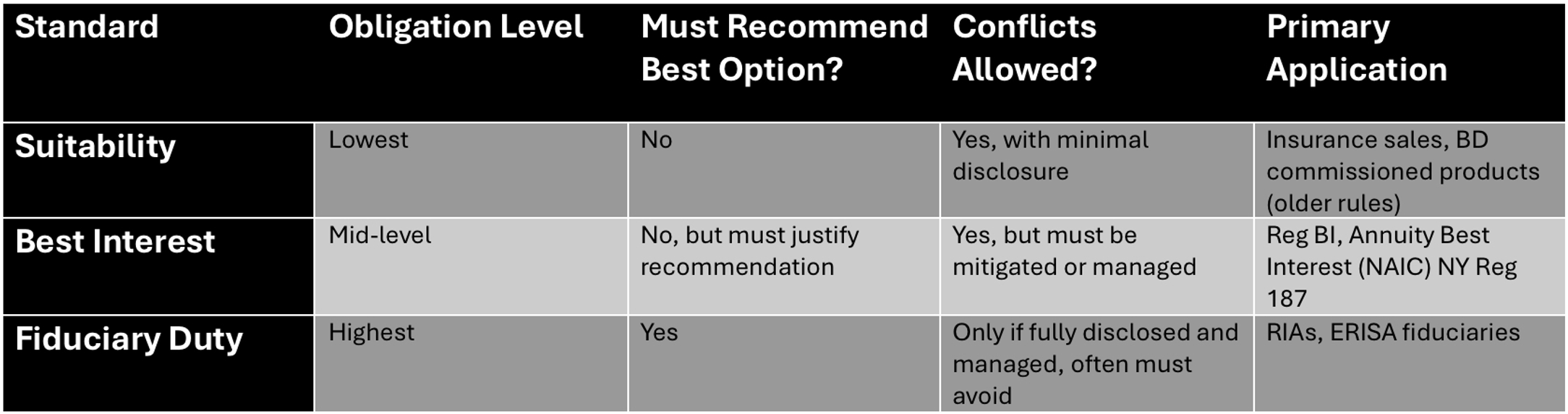
Side by Side Comparison
How This Shows Up in Insurance Specifically
For ordinary fixed life insurance, most states do not impose a fiduciary or Reg BI-type standard. The applicable duties arise from state insurance law, including suitability requirements where applicable, misrepresentation rules, replacement requirements, illustration rules, and other producer conduct standards.
New York (Reg 187) requires Best Interest for life and annuities. Nearly all states have adopted the NAIC’s Best Interest revisions for annuity transactions though the NAIC model does not generally extend that standard to ordinary life insurance. Most insurance agents are not fiduciaries merely by virtue of holding an insurance license. Fiduciary obligations may arise, however, from an investment advisory relationship, ERISA, state law, contractual undertakings, given professional designations or other facts and circumstances.
Bottom Line
- Suitability: “This fits.”
- Best Interest: “This fits and appears better than the alternatives considered.”
- Fiduciary: “This is the best overall option for you, and I must put you first.”
An Example
When thinking of an example to demonstrate this, I quickly turn to real life scenarios I encounter frequently, especially in my litigation support work. It is common to be brought into life insurance transactions built around Indexed Universal Life (IUL). I will be clear that IUL policies are not inherently improper, but as with all financial products, or any product for that matter, context matters. Also, IUL policies are the life insurance product behind most premium financed life insurance and retirement planning, focuses of my work.
Below is a realistic and defensible example of a sale where an indexed universal life (IUL) policy may satisfy the Suitability standard but would be difficult to justify under a best interest or fiduciary framework.
Scenario Summary
- Client: 45-year-old high-income professional
- Goal: Long-term cash value accumulation to supplement retirement
- Risk tolerance: Moderate to high
- Time horizon: 20+ years
- Needs/Desires: Life insurance death benefit, maximum accumulation, cost efficiency, tax efficiency, transparency, long-term performance
- Qualified plans already maxed out
Product Options for this Analysis
- IUL: 10% cap, 0% floor[5], typical charges, illustrated at a hypothetical illustrative rate of 6.0% under AG49B[6]
- Variable UL (VUL): Low-cost platform, competitively priced investment options, hypothetical illustrated return ~7% – 8%, transparent underlying investment risk
Both offer permanent coverage and cash value growth. Note: clearly there are other investments available. This analysis only comparing the two life insurance options in the event life insurance is part of the solution and because life insurance is commonly recommended in the market for supplemental retirement planning. This piece is not intended to posture life insurance as a better alternative.
As with any variable product, VUL cash values fluctuate with the performance of the underlying subaccounts and are not guaranteed. The policy owner bears the investment risk.
The Recommendation: IUL
The agent recommends the IUL as a “safer accumulation tool” with downside protection. Under traditional suitability rules the sale could pass because the client wants permanent insurance, accumulation potential, likes the idea of a 0% floor and claims a moderate to high risk tolerance. The IUL is not inherently inappropriate, and the product objectively fits the client’s general goals and risk profile.
This would pass the Suitability standard and is why most IUL sales clear compliance under basic suitability. However, this may not in the best interest of the client Under Best Interest rules (Reg BI or NY Reg 187–style) for a number of reasons.
One reason is that it fails to consider cost efficiency. The VUL platform includes low-cost index sub-accounts[7], low overall drag over the long term[8], higher long-term return potential and no cap limiting upside over decades.
The IUL cap (10%) mathematically reduces the client’s long term outcome relative to equity exposure, especially over 20–30 years for a 45-year-old, in addition to common equity exposure during retirement years. A traditional S&P 500 IUL crediting strategy generally references the price index rather than the S&P 500 total return index and therefore does not include dividends. Given the lack of dividends and the cap, the upside potential of an IUL policy is much lower than most people understand and expect.
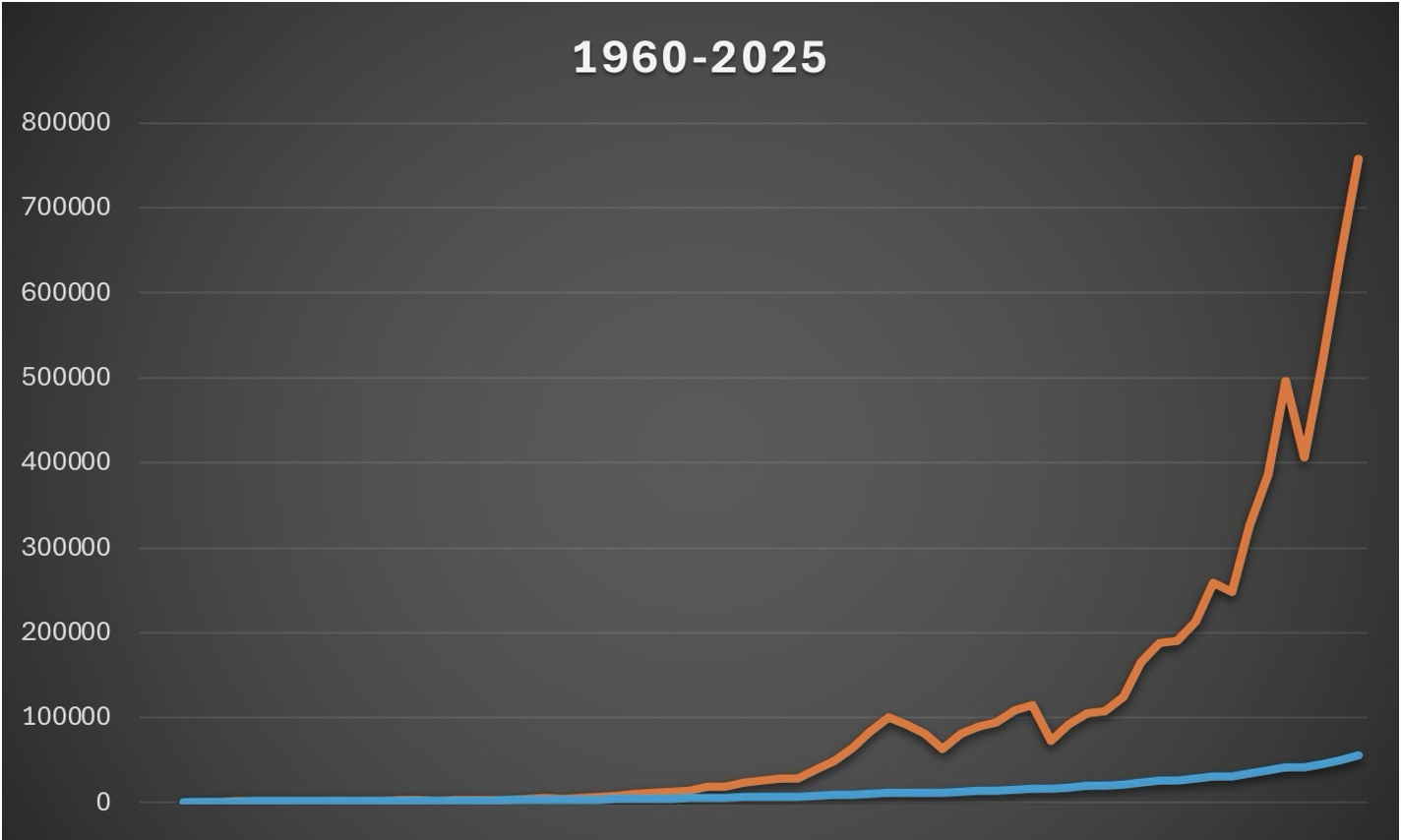
S&P 500 Compared to the S&P 500 Exclusive of Dividends and with a 0% Floor and 10% Cap
The AG49 look back period – $1,000 one time payment
This recommendation also fails to consider the client’s true risk capacity. The client has a long time horizon, high income stability and has a higher risk capacity than risk aversion. These factors tilt the balance toward equities exposure through variable life over capped crediting.
There is also a failure to demonstrate that the IUL’s limitations were outweighed by its benefits. The agent cannot justify why buying capped returns with higher long-term implicit option costs and path-dependency risks[9] is better for an accumulation goal than direct market exposure.
There is a failure to document why alternatives were not chosen. Best interest requires evaluation of alternatives, consideration of costs, features and complexity, and documentation that the recommendation is in the client’s best interest. No such process exists in this example.
This may not pass the Best Interest standard. On the facts assumed here, I do not believe the IUL recommendation could be adequately supported under a Best Interest analysis absent additionalfacts demonstrating why its benefits justified the lower expected upside and other limitations.
Note that neither Reg BI nor NY Reg 187 says VUL must beat IUL because its expected return is higher. In fact, SEC guidance specifically recognizes that a higher cost or riskier alternative can still satisfy the standard depending upon the investor’s profile and product benefits.
A fiduciary advisor would be required, within the scope of the advisory relationship, to consider the client’s overall objectives and circumstances, evaluate appropriate alternatives, analyze costs, expected return and risk, address material conflicts and have a reasonable basis for concluding that the advice is in the client’s best interest.
Crucially, for a 45-year-old with 20+ years until retirement and the assumed risk capacity, diversified equity exposure through a low-cost VUL offers materially greater long-term return potential than capped, option-budget-driven IUL crediting. That upside does come with its own tradeoffs. VUL has no floor and can decline depending on the underlying investment. While an IUL’s floor offers protection from market loss.
Considering a VUL has low cost fund options and is more efficient for long-term accumulation, and the IUL cap eliminates upside that the client’s risk profile supports may be red flags.
The IUL was chosen primarily because the advisor is insurance-only licensed and it can be structured to look attractive, whether the underlying assumptions are realistic. It was not necessarily drivenby commissions, but it was a situational recommendation, and the client was not shown a full risk/return trade-off. Fiduciary duty requires a prudent, client-centered process and advice in the client’s best interest, not because the product is available to sell.
This would be difficult to support under a Fiduciary standard. In my view, it would not satisfy a prudent fiduciary analysis on the facts assumed.
In this hypothetical, the IUL may satisfy a basic Suitability analysis because it fits the client’s general goals, but I believe it would be difficult to support under the higher standards assumed here because the VUL provides better long-term return potential, lower drag, a better match to the client’s time horizon and risk capacity and is statistically much more likely to accumulate the desired assets.
Note that this is not meant to promote one product over another. If the facts of the situation were different, the process may result in a different recommendation.
Policy Design Matters as Much as Product Selection
The product itself is only part of the equation. How the policy is structured can be just as important, if not more so. There are multiple design choices in a life insurance policy. For simplicity, consider the two primary death benefit options:
- Level Death Benefit (Option A): Fixed death benefit as cash value grows.
- Increasing Death Benefit (Option B): Death benefit equals initial face amount plus cash value.
For a practical comparison, we will assume a 45-year-old male makes a $30,000 annual premium through age 65. For policy 1 the death benefit will be $5 million and remain level and for policy 2 the initial death benefit is $500,000 and the death benefit will increase as the cash value grows.
Economic Impact
Policy charges, especially mortality costs, are driven by the net amount at risk (NAR: death benefit minus cash value). With a level death benefit, the NAR generally declines as cash value accumulates, depending on policy funding. With an increasing death benefit, the NAR generally remains the initial specified face amount.
The following is based off a VUL illustration for a 45-year-old male, rated Preferred Best, paying $30,000 annually from age 45–65, with an assumed hypothetical gross rate of return of 8%. The $500,000 death benefit policy is structured with an increasing death benefit through year 15, switching to level in year 16; the $5,000,000 death benefit policy is level from inception.
In this hypothetical example, Policy 2 begins with only $500,000 of specified insurance compared with $5 million under Policy 1, producing lower insurance charges and allowing substantially morepremium to remain available for accumulation. The best of both worlds may be starting with the lower initial death benefit to minimize charges and improve efficiency and then change to level death benefit when optimal that allows for the continued growing cash value to reduce the NAR to result in minimizing long term charges.
As a result, the increasing to level death benefit structure can produce significantly higher cash value accumulation. It also illustrates a larger death benefit over time.
In this example, policy 1 generates over 5 times the internal charges at age 95. Policy 1 also produces more than 8 times the commission compensation.

Note that this is true whether we are evaluating IUL or VUL.
In one scenario, where the expenses are dramatically higher, the cash value and death benefit ends up being much lower in later years. Take this one step further and assume the agent offers a premium option for $1,000 less annually for the same $5 million death benefit. Who wants to pay any more than necessary?
In that scenario the cumulative expenses at age 95 increase to $3,240,000 from $2,411,000, a 34% increase for a $1,000 annual premium savings. Furthermore, at the $30,000 premium the policy expenses increase roughly $100,000 in total if the individual lives to age 100. With the $29,000 premium the policy expenses from age 96 through 100 increase by over $3 million. However, this would still be a “suitable” transaction, even if it meant a dramatically lower probability of policy success.
Note the initial client goals, one of which was a need for death benefit. If the life insurance option with a lower initial death benefit is chosen, it may not satisfy this requirement even if it results in a greater death benefit in later years. It may be appropriate to consider low-cost term insurance and incorporate the cost of this coverage into the equation.

Standards of Care Implications
Suitability Standard
The higher level death benefit is not inherently unsuitable. If it aligns with the client’s general objectives, it can pass the Suitability standard.
Best Interest requires an evaluation of alternative structures, consideration of cost efficiency and analysis of long-term outcomes. Recommending a materially less efficient structure without justification creates a clear issue. On a Best Interest basis, this recommendation may fail.
From a Fiduciary standpoint the recommendation must optimize design for long-term outcomes, minimize unnecessary costs, and avoid or fully disclose conflicts. Selecting a structure that increases costs, reduces efficiency, and increases compensation may not withstand scrutiny. Policy 1 recommendation would likely fail the Fiduciary standard.
Key Takeaway
Policy design can have a greater impact on outcomes than product selection itself. A strong product built poorly can underperform a weaker product built efficiently, but this may only be revealed by an individual operating under a higher standard.
Differences in Advisor Obligations
Non-registered Agent
A life-only insurance agent generally is not subject to Reg BI or an investment-advisor fiduciary standard merely by virtue of selling fixed life insurance. The producer’s obligations instead arise primarily under applicable state insurance law, which varies by jurisdiction and may include suitability, best-interest, disclosure, replacement, illustration, and anti-misrepresentation requirements.
The lack of Best Interest or a Fiduciary standard surprises many clients and advisors.
There may also be some structural incentives and licensing considerations. In practice, some agents avoid securities licensing to avoid broker-dealer oversight as marketing materials likely do not require formal compliance review. Also, some agents are unlicensed for securities-based insurance sales due to prior regulatory issues.
It is also important to remember that we may have to look beyond the insurance transaction itself. There would likely be violations if the agent recommends the sale of securities to fund the policy or replacing a VUL policy. Some aspects of involvement in premium financing could also cross a line.
Registered Representatives
A Registered Representative (RR) operates under the supervision of a broker-dealer and is subject to securities industry rules and standards when acting in that capacity. Responsibility is different depending on what life insurance product is being recommended. When recommending a VUL the representative is subject to Regulation Best Interest (Reg BI). This includes an obligation to exercise reasonable diligence, care, and skill; understand the risks, rewards, and costs of the recommendation; consider the client’s investment profile and reasonably available alternatives; address material conflicts of interest and not place the representative’s or broker-dealer’s interests ahead of the client’s interests.
These rules can also be relevant when a life insurance recommendation involves the sale, liquidation, transfer, or repositioning of securities to fund the policy, even when the policy is not securities-based. However, merely holding a securities license does not automatically make an ordinary fixed life insurance transaction subject to Reg BI. The capacity in which the representative is acting and the nature of the recommendation matter.
In practical terms, an RR recommending a VUL cannot simply determine that the policy is “suitable.” The recommendation must satisfy the higher Reg BI standard applicable to the securities transaction. For an ordinary fixed whole life or universal life recommendation made solely in an insurance capacity, Reg BI ordinarily does not apply merely because the producer also holds a securities license. Applicable duties instead arise under state insurance law and any other duties created by the circumstances and relationship.
Investment Advisor Representatives
An IAR, when acting in an advisory capacity, operates under a fiduciary standard. The fiduciary obligation includes duties of care and loyalty and applies to the advisory relationship rather than merely to the execution of a particular transaction. The advisor must act in the client’s best interest, provide advice based on a reasonable understanding of the client’s circumstances, disclose material conflicts and avoid placing the advisor’s interests ahead of those of the client.
Even when the life insurance is not securities-based, if an IAR evaluates or recommends life insurance as part of an investment, retirement, estate or financial-planning engagement, the analysis cannot necessarily be isolated from the advisor’s fiduciary responsibilities simply because the ultimate product is insurance. If the advice is being provided within the advisory relationship, the advisor should be able to demonstrate why the strategy and product are consistent with the client’s overall interests and objectives.
This means an IAR considering life insurance as part of a broader financial plan should generally consider more than whether the policy technically works. Cost, product design, alternatives, liquidity, expected outcomes, conflicts and the role of the insurance within the client’s overall financial circumstances become part of the analysis.
Note that an IAR registration alone does not authorize the sale of VUL. An agent selling VUL must hold the required insurance license and securities registration through a broker-dealer. It is also important to understand that an IAR could act as agent for a fixed insurance product and thus be beholden to the lowest suitability standard if it is established that it is not a part of an advisory relationship.
Dual Licensed Advisors
Many financial professionals are both Registered Representatives and Investment Advisor Representatives. A dual-licensed advisor does not operate under one universal standard for every activity. The applicable legal standard depends upon the capacity in which the advisor is acting and the nature of the recommendation. The SEC specifically recognizes the distinction. When a dual registrant acts in a broker-dealer capacity, Reg BI applies to covered recommendations and when acting in an investment-advisory capacity, the Advisors Act fiduciary standard applies.
In real-world practice, however, the lines can become less distinct. If the advisor develops the client’s retirement or financial plan as a fiduciary, evaluates the client’s investment portfolio, recommends moving assets and then recommends life insurance as the solution, it can be difficult to credibly characterize the insurance recommendation as completely unrelated to the advisory relationship simply because the policy is ultimately sold through an insurance license.
The substance of the relationship matters. What advice was provided? How did the advisor hold themselves out? Was the insurance recommendation part of the financial plan? Were securities sold or repositioned to fund it? Did the client reasonably understand the advisor to be providing comprehensive financial advice?
A dual-licensed advisor therefore may have substantially greater obligations than an insurance-only producer. Depending upon the circumstances, the same overall transaction can implicate insurance suitability rules, broker-dealer best interest obligations, and investment advisor fiduciary duties.
When Things Go Wrong
The formal burden of proof in a dispute generally remains with the client or claimant under all three standards, but the advisor’s affirmative obligations increase substantially as the standard rises.
Under Suitability, the question is largely whether the recommendation reasonably fit the client’s circumstances and objectives. The advisor should have a reasonable basis for the recommendation, but the analysis may be comparatively limited.
Under Best Interest, the advisor must go further. The recommendation should reflect consideration of costs, risks, benefits, conflicts and reasonably available alternatives, and the advisor should be able to explain why the recommendation was in the client’s best interest rather than merely suitable.
Under a Fiduciary Duty, the advisor is subject to affirmative duties of care and loyalty and must place the client’s interests ahead of the advisor’s own. Although the formal burden of proof does not automatically shift, the fiduciary should be able to demonstrate the process, analysis, consideration of alternatives, handling of conflicts and rationale supporting the advice.
As the standard rises, the issue becomes less about whether the client can prove that the transaction was plainly inappropriate and more about whether the advisor can demonstrate that the recommendation process satisfied the higher standard of care.
Best Interest Versus Fiduciary Duty
This is where I often find much confusion. The fundamental difference between Best Interest and Fiduciary Duty is the scope of the advisor’s responsibility.
Under a Best Interest standard, the advisor must be able to demonstrate that the particular recommendation was in the client’s best interest based on the information reasonably available at the time. The advisor must follow all applicable considerations; however, the obligation is generally tied to the recommendation being made.
Under a Fiduciary Duty, the responsibility is broader. The advisor owes duties of both care and loyalty to the client and must act in the client’s best interest throughout the advisory relationship.The fiduciary must consider not simply whether a particular product is a good recommendation, but whether the overall strategy is appropriate in light of all the applicable considerations.
In simple terms:
Best Interest asks: “Is this recommendation in the client’s best interest?”
Fiduciary Duty asks: “What should I be advising this client to do, considering the entire relationship and putting the client’s interests first?”
Suppose a client says, “I want retirement income and I have $100,000 available to save.”
A life insurance agent operating under a best interest requirement applicable to the insurance recommendation might properly compare several insurance products and conclude that Policy A is preferable to Policies B, C, and D.
A fiduciary financial advisor arguably has to start one level higher: Should this client be buying life insurance for this purpose at all?
That could require considering taxable investments, qualified plans, bonds, separately managed accounts, insurance, or some combination. If insurance is appropriate, then the advisor asks which policy and design are best.
Best Interest is largely about making a defensible recommendation. Fiduciary Duty is about giving defensible advice.
An Analogy
Imagine a car salesperson. A prospective client walks in. The client owns a growing landscaping company and is looking for an additional vehicle. They need something for hauling equipment and materials. Their priorities include durability, cost efficiency, long-term value, and proper capacity for the job.
Under the Suitability standard the salesperson shows the client a midsize pick up truck. It can tow a small trailer, has space for tools and fits with the client’s general budget. The truck “works” for the job.
The salesperson does not compare heavy duty alternatives, long-term maintenance costs and whether the truck will be strained under daily commercial use. They also happen to earn a higher commission as this is a higher level model.
The outcome is that the truck gets the job done, for now, but it may wear out faster, may be undersized for realistic duties, may not be the most cost-efficient option long-term and did not need a high-quality sound system, carpet, and upgraded upholstery.
This passes Suitability. “It fits.” Even an SUV may pass suitability. Think of any vehicle that could work but clearly is not the best option for someone who was educated about the possibilities. It is arguable that in the insurance equivalent world, even a sedan could qualify.
Note: the salesperson was not required to ask the client the questions most consumers would assume are necessary to effectively learn about needs and objectives. Even if it’s more of a “I have something to sell so I’m going to say what it takes to sell it” mentality, the suitability standard can permit a surprisingly broad range of recommendations because the question is generally whether the recommendation is reasonably appropriate, not whether it is the most efficient or advantageous alternative available.
Considering the Best Interest standard, the salesperson evaluates multiple options, including light duty versus heavy duty trucks, gas versus diesel, upfront cost versus long-term durability and total cost of ownership. They recommend a heavy-duty truck that costs more upfront, last longer under commercial use and reduces long-term repair and replacement costs. They still earn a commission, but they can justify the recommendation.
The client gets a truck that is better aligned with actual usage, more efficient over time and more appropriate for business growth. The Best Interest standard is passed.
“This fits and is the best option among what I evaluated.” Most people would be satisfied with this, and few expect the salesperson to go above and beyond. The client may well be satisfied and never regret the decision.
Fiduciary Duty ramps things up. The advisor steps back and ask a broader question: “What is the best overall solution for this business?”
They consider buying versus leasing, new versus used fleet vehicles, whether a different vehicle type (flatbed, dump truck, or multiple small vehicles) is more efficient, financing structure and cash flow impact. They may conclude a used commercial-grade truck delivers the best value, or a different configuration of vehicles better serves the business.
They recommend the option that produces the best long-term outcome, even if it reduces their commission, requires more work and is not what they initially preferred to sell.
The outcome is the client gets the solution that maximizes business efficiency, long-term economics, and operational effectiveness. This passes the Fiduciary standard.
“This is the best overall solution for you, even if it’s not best for me, and I’ve documented it.” This is like concierge customer service compared to what most people would expect when walking in the door. This kind of experience is what people go out of there way to tell others about.
Bottom Line
- Suitability: The truck works
- Best Interest: A choice the salesperson can reasonably justify after considering appropriate alternatives
- Fiduciary: The client ends up with the best overall solution, truck or otherwise
If the options were known ahead of time, the decision of who to work with may be pre-determined.
Why This Matters
A landscaping owner who depends on their equipment for income would never knowingly choose a salesperson who is only required to sell them something that “works.” Yet, in financial services, especially insurance, which is often the default standard.
Final Thought
None of this means that a fiduciary cannot take advantage of a client or that an insurance agent operating under a lower legal standard cannot provide exceptional advice and put the client’s interests first. Many do. The important distinction is what the professional is required to do and what systems exist to hold that professional accountable when things go wrong.
An insurance-only producer is subject to state insurance laws, licensing requirements, carrier rules and prohibitions against misrepresentation and other improper conduct. But the producer generally does not operate within the same supervisory framework imposed on securities and investment-advisory professionals.
A Registered Representative operates within a broker-dealer supervisory system. Broker-dealers are required to establish written supervisory procedures, designate individuals responsible for supervision, review certain communications and business activities, conduct inspections, and maintain compliance systems designed to detect and prevent violations. An Investment Advisor Representative similarly operates as a supervised person of a Registered Investment Advisor (RIA) whose compliance program is intended to prevent, detect and correct violations of the Advisors Act and whose standards of conduct reflect the advisor’s fiduciary obligations.
For a professional who is both an RR and an IAR, those additional layers can include supervision by the broker-dealer when acting in the brokerage capacity and by the investment advisor when acting in the advisory capacity. Compliance personnel may question a recommendation, require additional documentation, restrict advertising or communications, examine conflicts, require changes to the proposed transaction or, in some circumstances, refuse to permit it.
That distinction becomes especially important after a transaction goes wrong. With a registered professional, there may be a documented trail showing what the advisor knew, what alternatives were considered, what disclosures were made, what supervision occurred and whether the firm’s policies were followed. The firm itself may also have independent supervisory responsibilities. With an insurance-only producer, those additional securities or advisory supervisory structures generally do not exist.
Registration therefore does not guarantee good advice, just as the absence of registration does not guarantee bad advice. What registration often provides is another layer of responsibility above the individual advisor, a firm, compliance department, and regulatory structure charged with supervising the conduct of the professional. That additional accountability can be every bit as important as the standard of care itself.
In summary, Suitability asks whether the recommendation clears an appropriateness threshold. Best Interest imposes materially greater obligations surrounding a covered recommendation. Fiduciary duty governs the advice within the scope of the advisory relationship and imposes duties of care and loyalty.
The opinions expressed are those of the author and should not be construed as specific investment advice. The examples given are hypothetical and for illustrative purposes only. Actual results will vary. Guarantees are based on the claims paying ability of the issuing company. Indices are unmanaged and do not incur fees. One cannot directly invest in an index.
Variable Universal Life (VUL) insurance involves investment risk, including possible loss of principal. Policy values fluctuate based on the performance of underlying investment options and are not guaranteed.
Bill Boersma is a CLU, AEP and LIC and the founder and owner of OC Consulting Group. More information can be found at www.OC-LIC.com, www.BillBoersmaOnLifeInsurance.info or email at bill@oc-lic.com or call at 616-456-1000.
Securities offered through Valmark Securities, Inc. Member FINRA, SIPC. Investment Advisory Services offered through Valmark Advisors, Inc., a SEC Registered Investment Advisor.
OC Consulting Group and its affiliates are separate entities from Valmark Securities, Inc. and Valmark Advisors, Inc.
[1] https://www.finra.org/rules-guidance/key-topics/regulation-best-interest
[2] https://content.naic.org/cipr-topics/annuity-suitability-best-interest-standard
[3] https://www.limra.com/siteassets/trending-topics/regulatory-compliance/regulatory/state-laws-passed/new-york—insurance-regulation-187.pdf
[4] https://www.govinfo.gov/content/pkg/COMPS-1878/pdf/COMPS-1878.pdf
[5] IUL crediting is a factor of the S&P 500 index or another index. Dividends are typically excluded. Regardless of index performance there is a floor, typically 0% and a cap rate, which is the highest crediting allowed. For example, an index with a 0% floor and a 10% cap will receive 0% when the market return is 0% or negative, 5% if the market return is 5% and 10% if the market return is 15%.
[6] https://content.naic.org/sites/default/files/inline-files/AG%2049A%28posted%29.pdf
[7] Referring to the potentially low investment expenses available in most insurance company VUL sub-account offerings. The sub-account is where the premiums and cash value are directed by the policy owner for purposes of investment and policy crediting.
[8] Referring to the efficiency of sub-account accumulation over time due to potentially low expenses and tax advantages inherent to life insurance.
[9] Path dependency risk means that the outcome depends not just on the average return, but on the order in which returns occur.